Chicken Road 2 — tournament-desk breakdown
The four risk modes and what they mean for variance
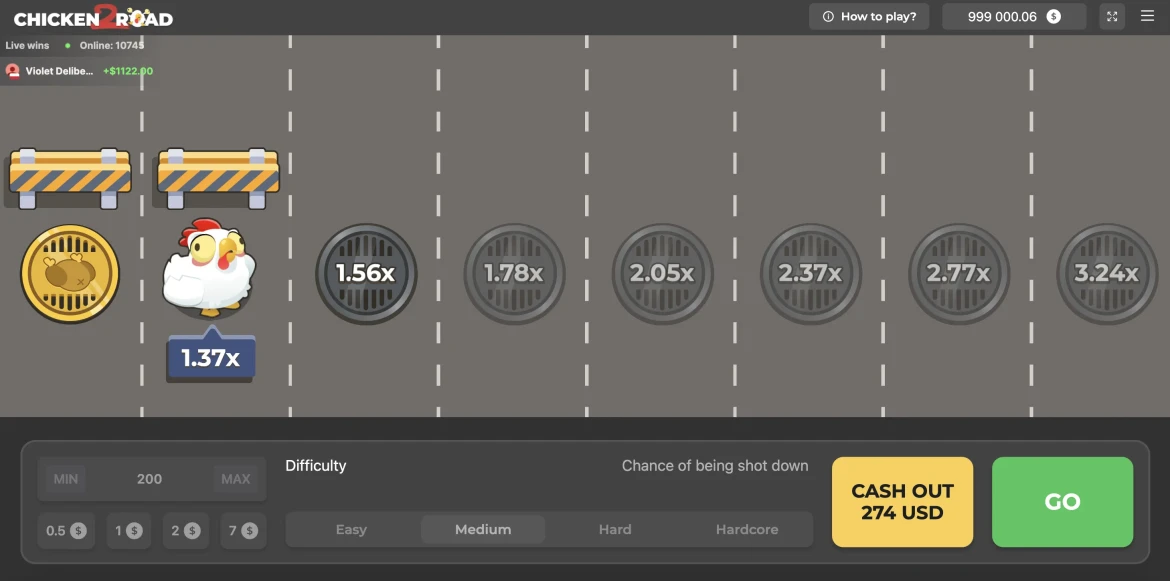
New in the sequel is a fourth variance track alongside the trio that shipped in 2023. You now toggle between Easy, Medium, Hard and Extra Hard on the round-selector before you commit a stake, and each pick rewires the underlying probability curve on the fly. Easy keeps a broad multiplier ladder opening at 1.02x — roughly one in three Easy rounds crashes under 2x on the round-latency data streaming off our servers, which is exactly what stretches a small stack at the C$0.10 floor. Medium loosens the payout window to a soft cap near 200x in exchange for shorter average runs.
Kick up to Hard and the low-multiplier hits get squeezed while the tail stretches out to 3,000x. Then Extra Hard — the mode exclusive to the sequel — unlocks the full 25,000x attic but pays back sub-1.5x on more than 60% of its rounds. The picker resets per round rather than per session, which is the piece most crash coverage undersells: you can rotate hot, dropping to Easy after a rough stretch and climbing back to Hard once the balance recovers. Every band converges to the same 98.00% asymptote in the long run — only the variance envelope, and thus your session-level standard deviation, actually changes.
Where Chicken Road 2 rewards discipline is cross-mode rhythm. Camping on Extra Hard will bleed a small bankroll inside twenty rounds; alternating with Easy protects principal while leaving budget for the occasional deep-tail swing. From session variance data streaming in from regulars on our floor, Extra Hard cash-outs between 800x and 4,200x are a routine sight during normal-length sits — that's the coefficient-of-variation payoff for players who can wait through the cold stretches.
Powerups and the partial cash-out hedge
Two mechanics debut in this build. The first is random powerups, which fire in-round at roughly one round in twelve: either a ×2 multiplier boost that instantly doubles whatever number the ladder is showing, or a bonus-coin drop valued at 5-20x your stake and credited direct to balance without a cash-out click. You cannot buy powerups — the trigger sits inside the round-engine algorithm and there is no Bonus Buy expected-value shortcut.
The second headline addition is partial cash-out. Mid-round at any point you can press the split button, banking 50% of your stake at the live multiplier while the other half keeps riding the ladder. Used with discipline it converts a 12x manual cash-out into a locked 6x plus a free continuation shot at 100x-plus — a proper hedge in Hard and Extra Hard rounds where the ceiling is worth the residual exposure. Think of it like laying odds on a scoop pot: you crystallise part of the expected value while keeping upside intact. Both manual cash-out and preset auto cash-out still work exactly as they did in the original tile.
Bankroll strategy and stop-loss discipline
Chicken Road 2 punishes sloppy discipline harder than the 2023 game because powerups inject short-window variance spikes the original never carried. Session shape our streaming desk recommends inside PowerUp:
- Session bankroll: 200x your base stake (C$20 at the C$0.10 floor, C$500+ at C$2.50) to absorb Extra Hard cold streaks without a reload — treat bankroll units the way you'd count big blinds
- Stake sizing: 0.5-1% of the roll per round; no chasing after back-to-back crashes, no tilting up after a bad beat
- Auto cash-out target: 1.8x-2.5x if you're camping Easy/Medium, or 10x+ for Hard/Extra Hard sessions
- Partial cash-out trigger: kick it in from 6x onwards in Hard rounds, from 15x in Extra Hard — the classic hedge threshold
- Mode rotation: any 500x+ cash-out is the cue to cool down to Easy and lock the gain, tournament-style stop-win discipline
Our welcome-bonus rollover caps individual stakes at C$5, so Medium is what we suggest for wagering runs — the compressed tail lifts the odds of turning the balance over before variance chews through it. Reserve Extra Hard for real-money play, not clearance grinding.
Mobile
The 2024 build was engineered portrait-first for phones, and the difference over the 2023 original is immediately obvious the first time you open it on iOS. Grid stays vertical, the cash-out button drops directly under thumb reach, and powerup pop-ups render in the top third rather than eating the multiplier readout. Total HTML5 asset payload is around 3 MB — painless on any Canadian mobile plan — and the crash animation clocks a steady 60fps on iPhone 11 and up, plus mid-range Android hardware from 2021 forwards.
Interac e-Transfer top-ups clear inside about 30 seconds while a round is live, so you can drop C$500 into balance mid-session without missing the next hop. Battery draw runs 4-6% per hour of continuous play on our test devices — a hair lower than a video slot because the crash engine skips the reel-particle system entirely.
Chicken Road 2 vs Chicken Road — the material differences
Same engine, four concrete departures. First up, the sequel bolts an Extra Hard band onto the original's Easy/Medium/Hard picker, lifting the top-line reward from 20,000x to 25,000x. Next, powerups (×2 multiplier boost or bonus coins) fire inside the sequel at roughly one round in twelve — the original ships without them entirely. Third, the sequel exclusively gets 50% partial cash-out; on the original your only option is full cash-out or bust. Fourth, sequel UI defaults to portrait on phones whereas the 2023 build still opens landscape.
Long-run return is identical at 98.00% either way, and the underlying crash-curve maths lines up cleanly across the three shared bands. If you are already comfortable with the original's rhythm and don't want mid-round randomness intruding on your read, stay on Chicken Road. If the higher ceiling and hedging tools appeal, Chicken Road 2 is the mathematically sharper play on the same money — especially for the variance-hunter demographic.
 P
P 🐔
🐔
 CHICKEN
 DRAGON
 BIGGER
 AMAZING
 CAISHEN
 WISH
WISH