Amazing Link Medusa — tournament-desk breakdown
Hold & Win bonus mechanics
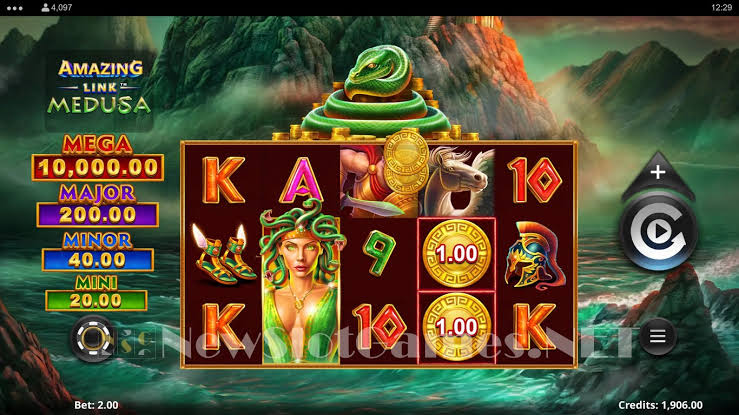
The bonus triggers the moment six or more Medusa-cash tiles land anywhere across the reels — base play is parked and the game switches to a dedicated Hold&Win grid. You start with three respins on the counter, and every fresh Medusa-cash tile that lands resets it back to three. Cash tiles carry stake-scaled C$ figures (the bottom rung pays 1x to 50x, the top rung tops out with a 500x showpiece at max bet), and above the grid you can read all four static jackpot markers: Mini 20x, Minor 50x, Major 500x and Grand 5,000x.
Two exits are possible. Either the respin counter runs to zero, or every single one of the 15 cells locks. Fill the entire grid and the Grand jackpot at 5,000x stake drops on top of whatever cash-tile total you've already banked — that's C$1,000 from a C$0.20 floor spin, and C$25,000 from a C$5 stake. Compare that against the Major, Minor and Mini prizes, which appear as static C$-labelled tiles at any point during the respins rather than being conditional on a full board.
Coefficient of variation on the bonus trigger is high — the Hold&Win surfaces once every 180 base spins on average, in line with the wider Amazing Link line-up. Because that trigger owns almost the whole RTP, treat every activation like a final-table hand: switch autoplay off and watch the respins with your eyes actually on the screen.
Free spins and Freezing Wilds
The second route into a bonus round runs through three Medusa-portrait scatters, which deals out 15 free spins played across the standard 5×3 layout. During free spins the maths shift: any wild that drops converts into a Freezing Wild, locking into its cell for the remainder of the round and pushing wild coverage further across the reels with each subsequent spin. No multiplier ladder is stacked on these wilds — the return contribution is built purely on the compounding board coverage they accumulate.
Retriggers stack cleanly — a further three scatters buys another 15 spins — and any Medusa-cash tiles pulled in during free spins funnel into a Hold&Win at the round's close on top of what free spins have already paid. The realistic path to touching the 5,000x cap runs through a lengthy free-spin sequence that then feeds a Hold&Win where the Grand actually lands.
Bankroll strategy and session variance
Base play here is thin by design — the base-game hit rate for any pay at all sits around 1 in 4 spins and most of those clock in below 1x stake. The whole RTP calculation is wrapped tight around the Hold&Win, which surfaces roughly once per 180 base spins. From a tournament-discipline standpoint, a workable session shape looks like:
- Bankroll floor: 200x your base bet (C$40 at the C$0.20 minimum, C$100 at C$0.50) to absorb base-game variance without going short
- Bet sizing: hold each spin at 0.5-1% of session bankroll — classic bankroll-management ratio, no chasing a cold streak by ratcheting up
- Autoplay in 50-spin chunks with a stop-loss pegged at 30% of the session budget; treat it like a poker tournament re-buy threshold
- No Bonus Buy is available on this build — so there's no expected-value shortcut, the Hold&Win only comes through natural triggers
- Kill autoplay the moment a Hold&Win lands and play it manually — those respin windows genuinely shift the outcome
Mobile at PowerUp
The 5×3 grid ships portrait-first — no forced landscape rotation, no pinch-zoom required. Games Global's HTML5 package tips the scales at roughly 5 MB for the full asset pull, well inside Canadian mobile-data comfort zones, and the Hold&Win animation holds a steady 60fps on any handset released from 2020 onwards, entry-level Android included. Because we stream 24/7 straight through the mobile browser, there's no App Store or Play Store install to chase.
Battery burn runs somewhere between 5% and 8% per hour of unbroken spinning on an iPhone 12 or the Android equivalent — the snake-scale background is a looped video clip, not a per-frame particle rig. The default Hold&Win entry sting is on the loud side; dialling in-game volume back to around 40% pays off during longer speaker sessions, especially on the road.
Medusa vs Amazing Link Zeus — what actually differs
Both slots share the Amazing Link Hold&Win engine, but their maths diverges in a small but meaningful way. Medusa ships 96.02% RTP versus 95.02% for Zeus, so over the long run Medusa returns roughly 1% more of the pooled stake volume — a 1% edge on a high-variance slot is not nothing. The jackpot rungs are copy-paste identical — Mini 20x, Minor 50x, Major 500x, Grand 5,000x — and both need the same six Medusa-cash tiles to trigger.
The real playing-difference sits in the free-spin layer. Zeus swaps Freezing Wilds for a lightning-multiplier ladder. If a more active base-game feature is what you want, Zeus takes that vote; if you want the higher headline RTP and the accumulating wild coverage Medusa builds, this is the mathematically stronger side of the pair for bankroll-first play.
 P
P 🐍
🐍
 BIGGER
 CAISHEN
 DRAGON
 WISH
WISH GOLDEN
 PIGGY
PIGGY