Wishwood — review
Megaways engine
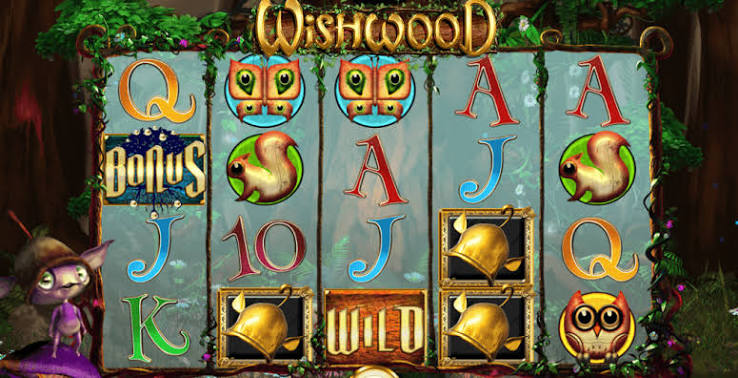
Wishwood is powered by Big Time Gaming's proprietary Megaways engine — licensed to studios across the industry, but here in its native form on BTG's own hardware stack. Each of the six reels displays between 2 and 7 symbols on every spin, and the total ways-to-win count is recalculated in real time as the product of every reel's symbol count. Land 7 symbols across all six reels and you're playing at the full 117,649 ways; the more routine 4-4-5-5-4-5 layout puts you at 8,000 ways. Wins trigger any time 3+ identical symbols land on consecutive reels reading left to right.
Tumbling reels carry the rest of the load. Every winning combination fires a cascade: paying symbols disappear, the remaining tiles drop down, fresh tiles fall in from above. That cascade keeps running until a spin lands with no new win, meaning a single triggering spin can unfold into a chain of consecutive payouts. Across my Wishwood sessions on our floor, chains of 4-5 tumbles land routinely; anything reaching 7+ tumbles typically flags an incoming Free Spins trigger via the accompanying scatter accumulation — call it the equivalent of feeling the board texture shift when the flop hits your range.
Free spins & multiplier
Wishwood earns its 40,000x ceiling inside the bonus round. Landing 4+ scatter tiles anywhere on the reels drops you into Free Spins along a fixed ladder: 4 scatters = 12 free spins, 5 scatters = 15, and 6 scatters = 20. Any additional scatters that drop inside the round add 2 spins each on top — retriggers are uncapped, so a hot round can stretch comfortably past 30 spins.
The real magic sits in the multiplier mechanic. The bonus opens at a base multiplier of 1x, and every winning tumble inside Free Spins increments that multiplier by 1 — permanently, with no upper cap. A cascade of 6 tumbles bumps the multiplier to 7x for every subsequent win in that round; a later chain of 5 tumbles pushes it to 12x, and it keeps going. The only realistic route to the 40,000x ceiling is a long-running Free Spins round where the multiplier stack has climbed into the double digits before a hefty tumbling chain lands across a high-symbol Megaways configuration. Session variance calc: at a healthy 15x multiplier, a single 400-ways payout at 5x symbol value cashes 6,000x — genuine bounty-tier money on any stake north of C$1.
Bankroll strategy & Bonus Buy EV
Base play on Wishwood is intentionally thin — expect the base game to hover around break-even at best over most sessions, since the bulk of the RTP is concentrated inside the Free Spins round. Trigger frequency lands on average around one bonus every 180-220 base spins, and roughly 1 in 4 of those triggered rounds delivers a payout worth writing home about. Here's my tournament-precision session shape: start with a minimum bankroll of 300x your base bet (C$60 at the C$0.20 minimum, C$1,500 at C$5 stakes, up to C$30k for a serious C$100 high-roller sitting) to absorb the very-high-variance swings; keep stake sizing at 0.3-0.5% of session bankroll per spin — smaller than you'd use on a standard high-variance slot, because the wait for a bonus is longer here; run autoplay in 100-spin blocks with a hard loss-stop at 40% of your session budget. On the 100x Bonus Buy: the EV maths on this button matters — at C$0.20 that's C$20 per buy, at C$5 that's C$500, and at the C$100 max stake it's C$10,000 per attempt. Average buy return sits around 95-100x, so per-buy expected value is roughly neutral to slightly negative. Budget for 20+ empty buys before a headline hit lands, and understand that 100x cost mathematics: 10 buys at C$5 stake = C$5,000 committed, and if none of them punch through the multiplier stack, that's on you, not variance being unfair. Don't chase after two empty buys, because Free Spins RNG genuinely doesn't remember the previous outcome. And Bonus Buy is disabled while our welcome-bonus rollover is active, since buys void the bonus at most Canadian-facing operators.
Mobile
The 6-reel Megaways layout scales cleanly into portrait phone orientation — BTG's UI shrinks the reel windows intelligently rather than forcing a landscape flip. Full asset weight lands around 7 MB, so first-load takes a few seconds on 4G but stays inside most mobile-data ceilings. BTG's rendering engine holds tumbling animations at a steady 60fps on any handset from 2020 onwards; the multiplier tick-up audio cue is loud on default settings, and it's worth dropping to around 50% for longer sessions where you want your concentration on the multiplier count rather than the SFX.
Battery drain on Wishwood runs moderate at roughly 7-9% per hour of continuous play on iPhone 12+ or comparable Android, because the animated forest backdrop is a per-frame particle simulation rather than a static video loop. On budget Android hardware from 2018-2019 we've clocked occasional frame drops during heavy multi-tumble chains — the game remains playable, but the smoothest experience needs mid-tier hardware or better.
Wishwood vs other Megaways titles
Stack Wishwood against BTG's earlier Megaways headliners — Bonanza (the original), White Rabbit, Extra Chilli — and it posts one of the higher published RTPs in the studio's own catalogue at 96.44%. The uncapped multiplier is a genuine rarity: most Megaways titles limit the ladder to 10x or 15x, and Wishwood's uncapped ceiling is precisely why the top payout stretches to 40,000x rather than the more typical 10,000x-25,000x on peer titles.
The cost of that ceiling is variance: Wishwood sits at the very top of BTG's own volatility rating (5/5), so cold runs between Free Spins triggers can genuinely stretch out. If you'd rather have more frequent base-game feedback and can live with a lower cap, White Rabbit or Extra Chilli are the friendlier BTG choices. If your goal is the biggest possible single-session Megaways windfall — the kind of headline hit a serious C$10k+ bankroll can actually chase — Wishwood is mathematically the strongest option in our lobby.
 P
P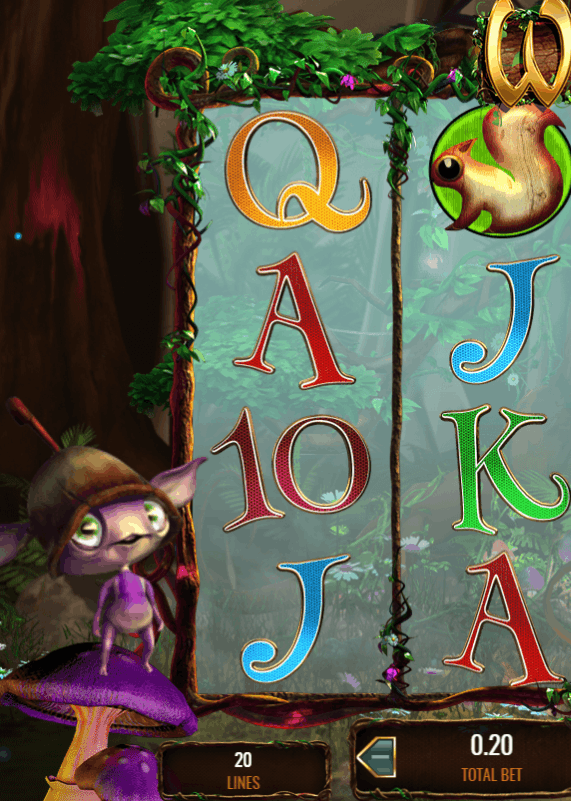 🌲
🌲
 AMAZING
 BIGGER
 POWER
POWER WOMBAROO
 DRAGON
 GOLDEN