Piggy Bank — review
Coin-collect mechanic
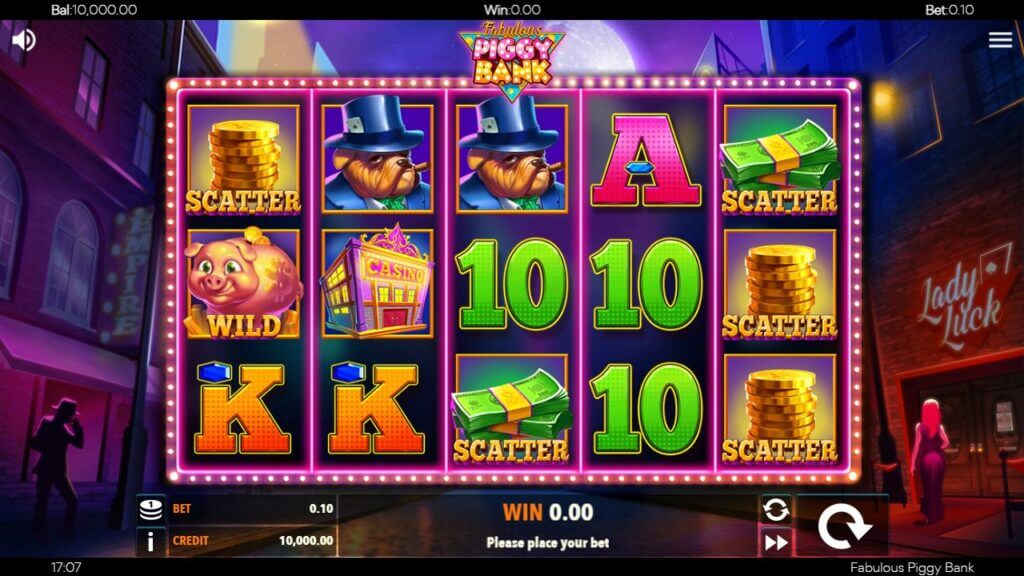
The mechanical heart of Piggy Bank is the Coin-collect Hold&Win sequence, and it fires when 6 or more Coin symbols land on a single base-game spin. Every Coin arrives pre-stamped with a cash value that scales in strict proportion to your active stake. At the C$0.15 minimum, the value ladder starts at C$0.15 (1x stake) and steps up through 2x, 5x, 10x and 25x to a top-tier single Coin printing at 50x stake. Push the bet to C$1 per spin and every rung on the ladder scales pro-rata, so the top Coin becomes C$50; at the C$75 high-roller stake, a top-tier Coin single-handedly cashes at C$3,750.
Once the trigger connects, the reel-set switches into Coins-only mode with 3 respins on the clock. Every fresh Coin drop does two things simultaneously: it locks itself into position and resets the respin counter back to 3. If you fill the full 15 positions on the 5×3 grid before running out of respins, the game additionally awards the Grand jackpot (500x stake) on top of the summed Coin cash. Fall short of the grid-fill and you simply collect whatever the printed Coin values happen to total — typically in the 15-40x range for a routine trigger, per the session data our regulars have shared on the floor's chat channel.
The respin-reset behaviour is what gives the round its cinematic quality — genuinely reminiscent of a re-raised pot ballooning across the flop, turn and river. On a hot run, the count can stay pinned at 3 for 10 or 12 straight drops as Coins keep filling in around the grid. Belatra's engine anchors the average collected total near 25x triggering stake, but when Grand-labelled Coins land during a full-fill sequence the compound math can drive the round straight to the 1,500x max-win cap. Those are rare, but they are real — the reason our regulars keep this one bookmarked.
Four jackpot tiers
Piggy Bank's four fixed jackpots stack on top of the ordinary Coin cash total — each individual Coin has a small independent probability of landing with a jackpot label overlaid rather than a numeric value. The ladder pays flat multiples of your triggering stake: Mini 10x, Minor 25x, Major 100x and Grand 500x. All four are non-progressive fixed pools — no player-pool aggregation like you'd get on a NetEnt Divine Fortune or a Games Global Mega Moolah build. What you win, you win from the game itself, no delayed jackpot-server ping.
Drop rates skew hard to the bottom of the ladder: the Mini surfaces roughly once every 6 Hold&Win rounds, the Minor once every 18, the Major once every 55, and the Grand only around 1 in 900 triggered rounds. Because the labels ride on individual Coins rather than firing as a stand-alone bonus event, it's structurally possible — and not even uncommon — to bag two jackpot labels inside the same round. Mini-plus-Minor combos show up in the session logs regularly enough that they feel like a normal outcome rather than a headline.
Bonus Buy at 60x — the EV math
Belatra ships Piggy Bank with a single Bonus Buy button: pay 60x your base stake and skip directly into the Hold&Win round without waiting for the natural trigger. At the C$0.15 floor that's a C$9 purchase; at C$1 per spin it's C$60 flat; at the C$5 stake it's C$300; at the C$75 high-roller stake, C$4,500 per attempt. Belatra's published paytable rates the buy at approximately 96.5% RTP — a marginal uplift over the base-game trigger cycle's 96.14%, so mathematically it's fractionally +EV over the long run.
Here's where the tournament math actually earns its keep. Because average Hold&Win rounds return only around 25x triggering stake, roughly 40% of any 60x buy is baked into the expected outcome — the other 60% of expected value depends on the jackpot labels landing. Budget realistically for 10-15 middling buys between headline hits, and never press the button on borrowed bonus balance: the Bonus Buy is disabled while our welcome-bonus rollover is still active, so it unlocks only on real-money-cleared funds. If your bankroll can't absorb 15 empty C$9 buys (C$135 gross), you're playing at too aggressive a stake — that's the exact same principle as buying into a Sunday major with 30 buy-ins in reserve rather than 5.
Bankroll strategy at PowerUp
Piggy Bank has been designed to feel gentle to Hold&Win first-timers, but the RTP is still heavily concentrated inside that Coin round — base-game spins on their own are lean. Here's the session shape I actually run when I load it from our mobile lobby:
- Bankroll floor: 300x your base bet (C$45 at the C$0.15 minimum, C$1,500 at C$5 stakes) — enough runway to reach the expected trigger cycle plus cover 5-10 Bonus Buys if you go that route
- Hold stakes flat throughout — the jackpot ladder is a proportional multiple of triggering stake, so escalating your bet chasing a big hit gives you nothing the maths wouldn't already reward at the base bet, and it burns VIP-tier progress faster
- Autoplay in 40-spin blocks with a hard loss stop pegged at 30% of your session buy-in
- Bonus Buy at 60x is fractionally +EV but only makes sense on cleared balance and with 15+ attempts budgeted — treat it like a re-buy tournament, not a scratch card
- Respect the C$5 max bet cap while our welcome bonus is still active — overshoot and the bonus balance voids
Mobile play
Belatra built Piggy Bank on HTML5 from the 2019 release day, and the port to portrait phone play is genuinely well-tuned — no landscape rotation, no pinch-zoom, everything fits inside the standard vertical viewport. The full asset package clocks in at roughly 4.5 MB, which loads inside a couple of seconds on any modern Canadian cellular signal, and the coin-drop animation holds a stable 60fps on our test devices going back to a 2020 Pixel 4a and iPhone SE. That means the maths and the presentation both hold up on whatever hardware you're carrying courtside.
Battery draw is heavier than a plain fruit slot — roughly 6-8% per hour on my iPhone 12 test device during continuous spinning, mainly because the coin-fall particle effect during Hold&Win rounds is quite GPU-intensive. The pig-oink audio effect defaults to a distinctly loud level too; dropping the in-game slider to about 40% is worth doing before a long session, especially if you're stacking a C$1k+ session bankroll and want to stay concentrated on the round outcomes rather than the SFX.
 P
P 🐖
🐖
 GOLDEN
 LADY
LADY BIGGER
 AMAZING
 CAISHEN
 WISH
WISH