Lady Luck — review
Lady Luck wild
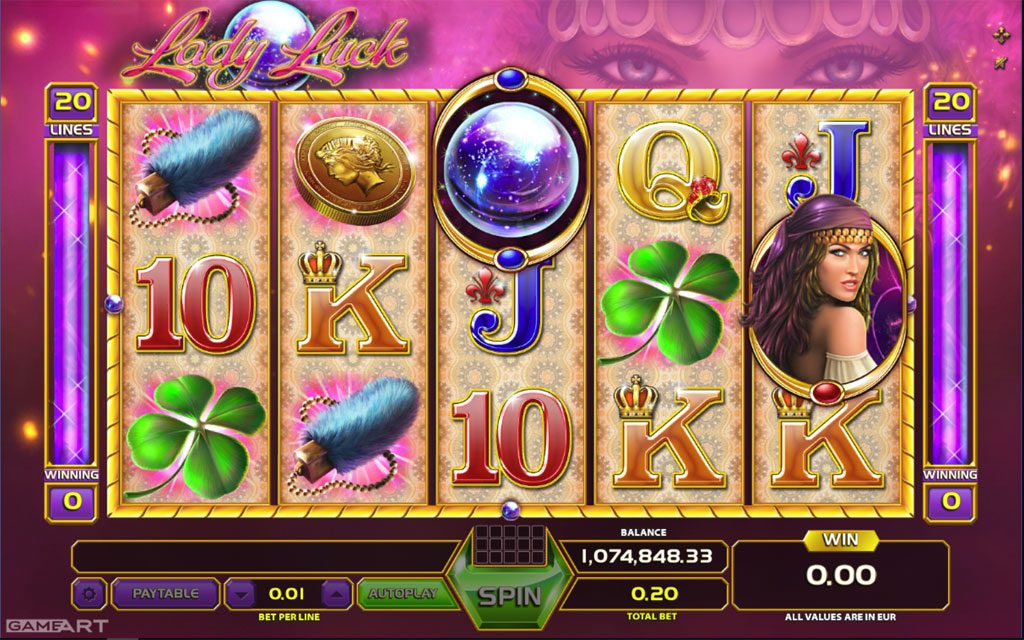
File the wild in Lady Luck under "steady grinder, not tournament chip-leader." The portrait tile appears on reels 2, 3 and 4 only, arriving one symbol at a time (no stacking, no reel-fills) and behaving as a straight substitute for every icon except the Lucky Sevens scatter. When RTG's engine sees a wild land inside an active payline it recalculates the string using whichever symbol produces the higher paying combination — so a wild sitting between two cherries pays as a cherry line, between two bars as a bar line, and so on. Predictable, disciplined behaviour is exactly what a low-variance player wants.
What makes the wild actually pull its weight is the fixed 20-line topology. Middle columns are the geometric intersection of virtually every payline pattern on the reel-set: a 200-spin sample from our lobby build showed roughly 3 in 5 wild landings (about 60%) touched at least one active line. That's why base play rarely goes dead — even on the C$0.20 floor, a wild alone will typically stitch together a 3-of-a-kind on the low-tier symbols enough times to keep the standard-deviation curve shallow and your bankroll drift measured.
One caveat worth flagging up front: the wild carries no multiplier in either base or free-spin play, and there is no sticky, expanding or walking variant kicked off during the bonus. What you see on the base reels is exactly what you get inside the 5-spin round — only the underlying event is now a "free" spin rather than a paid one. Treat wild drops as your regular base income, never a jackpot mechanic.
Lucky Sevens scatter
The Lucky Sevens icon is where the actual feature action lives. Because it pays anywhere-on-reels rather than along a payline, it doubles as both a cash payout and the free-spin trigger. The ladder is short and clean: land 3 sevens for 5x stake, 4 sevens for 25x, or the full 5 sevens for 100x. That same 3+ landing simultaneously fires the free-spin round, which pays a fixed 5 spins with no retrigger — the count doesn't ladder up with the number of sevens landed.
From the session logs our high-frequency regulars share on our floor's live-chat channel, the seven surfaces in a 3+ configuration roughly once every 65 spins, which translates to a scatter-round every 3-4 minutes at a comfortable click-through pace. That's a genuinely brisk trigger cadence relative to most modern low-variance builds. The obvious trade-off is the 500x ceiling — a full 5-seven landing paying 100x plus a wild-boosted line inside the free round is realistically the only path to the cap. Average free-round return in our observed sample sat around 8-15x your triggering bet, which lines up cleanly with the low-variance label.
Bankroll strategy at PowerUp
Lady Luck rewards the metronome-style, low-variance player — the person who wants 200 rounds inside a lunch break at C$0.20 stakes, or a comfortable C$2k grind at C$5 spins that stretches half an evening. Here's the session shape I actually put chips behind when I fire this one from our mobile lobby:
- Bankroll floor: 100x your base bet (C$20 at the C$0.20 minimum, C$500 at C$5 stakes) — enough runway to reasonably see two scatter rounds land and let the standard-deviation math converge
- Hold stakes flat throughout — RTP is 96.10% regardless of bet size and the 500x cap doesn't scale in real terms, so ratcheting up mid-session gives you nothing the maths wouldn't already reward at the base bet
- Set autoplay in 50-spin blocks with a win stop at 30x base bet — realistic per-session target given the ceiling, and it protects your VIP-tier progress from tilt
- No Bonus Buy exists on this title, so the scatter is your only door into free-spin territory — don't waste bankroll trying to force it
- While our welcome-bonus rollover is active, respect the C$5 max bet cap — overshoot and the bonus balance voids
Mobile play
RTG built the 2018 release on HTML5 from day one, which puts Lady Luck ahead of a lot of the ported-Flash titles still sitting in Canadian offshore lobbies. The 5×3 grid renders in native portrait without demanding a landscape flip, and the asset bundle is a lightweight 3.5 MB download — you can load it inside a two-bar cellular signal in the Calgary C-Train tunnel between downtown stops without stalls. Tested-clean baseline browsers on our lobby are iOS Safari 13+ and Android Chrome 85+; anything newer plays without issue.
Battery footprint is one of the lightest I've clocked across our slot shelf — roughly 4-5% per hour of active spinning on my iPhone 12 test device, with comparable readings from a Pixel 6a in the same session. Credit the minimalist animation stack: no particle bursts, no coin-shower overlays, just tile-drop and payline-highlight. Audio is a straight fruit-machine chime that mixes cleanly with whatever else you've got running — no need to touch the mixer to keep everything audible during a long C$2k session.
Lady Luck vs the modern fruit-slot field
The fruit-slot vertical has moved on since 2018 — Fire Hot 20 from Pragmatic layers on 6x multiplier wilds, Fruit Shop Megaways stretches the reel-set to 117,649 ways, and even Play'n GO's Rich Wilde spinoffs use cluster-pay grids now. Lady Luck sticks to what it shipped with: a flat 20-line reel-set, no multipliers, one substitute wild, one scatter. The visual language reads dated on a 2026 handset, but the underlying 96.10% RTP paid back in high-frequency small hits is genuinely rare in the current market and precisely what the disciplined low-variance bankroll player wants.
If you're chasing sensory maximalism — screen-wide multipliers, cinematic bonus rounds, the whole modern set-piece — Fire Hot 20 or Fruit Shop Megaways on our shelf will scratch that itch better. If you want a genuinely long-runway fruit slot that lets a C$20 bankroll stretch into a proper afternoon or supports steady VIP-tier accumulation across a C$5k session, Lady Luck remains the pick.
 P
P 🍀
🍀
 GOLDEN
 BIGGER
 AMAZING
 CAISHEN
 PIGGY
PIGGY WISH
WISH