Wombaroo — review
Expanding reels mechanic
Wombaroo's signature mechanic is the way the reel window physically resizes as the round progresses. Base play sits on a standard 5x3 grid with 243 ways to win — wins land left-to-right on any adjacent reels wherever identical symbols meet. The paytable climbs from low-value playing-card royals up through outback picture symbols (dingo, emu, kangaroo, wombat), with the wombat topping the ladder at 30x for a full 5-in-a-row line at max stake.
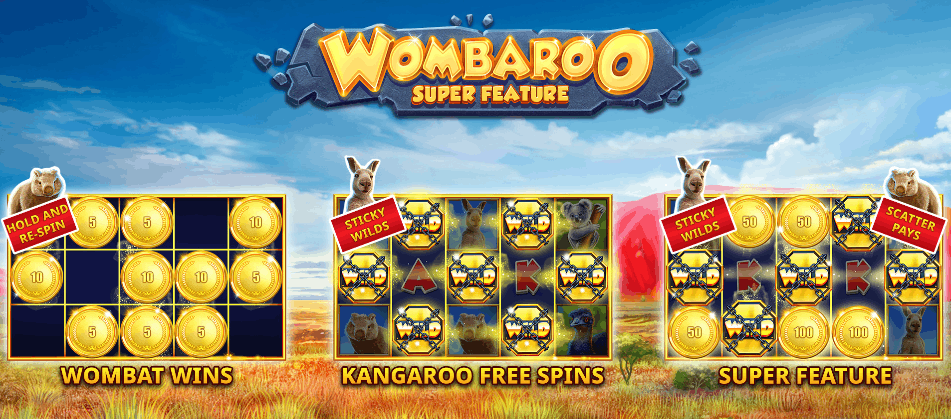
The round changes gear in Free Spins. The bonus opens on the base 5x3 grid, and each time a Sticky Wild lands and locks in place, the reel window steps up by one row. Two Sticky Wilds shift the grid to 5x4 (1,024 ways unlocked); a third pushes it to the full 5x5 (3,125 ways). That expansion holds for the remainder of the round, so a fast start with early Sticky Wilds sets the tail of the round running at the highest possible ways count — and the Sticky Wilds themselves stay locked, feeding into every subsequent spin. It's the mechanical equivalent of catching top-two on the flop and holding through both later streets.
Free spins & sticky wilds
Land 3+ scatter tiles to trigger the Free Spins round: 3 scatters = 8 free spins, 4 = 12, 5 = 16. Any additional scatters that drop inside the round retrigger for another 3 spins each, up to a soft cap around 40 total. The round opens on the 5x3 grid at 243 ways, and the reel-expansion mechanic outlined above then carries the load.
Sticky Wilds are the round's secondary headline act. They can land on any reel except reel 1 during Free Spins, they hold their position for the remainder of the round, and each one contributes both to reel expansion and to substituting for any regular symbol in a winning combination. The mathematically standout scenarios come when 3-4 Sticky Wilds land within the opening few spins — the grid expands to 5x5, ways rocket to 3,125, and the remaining spins run with a locked wild-substitution board that routinely serves up multi-way wins per spin. Realistically, the 20,000x ceiling is only reachable through this stacked-wild endgame.
X-iter buy tiers — the EV maths
ELK's X-iter feature buy is one of Wombaroo's genuinely under-appreciated party tricks — the four-tier structure is what makes it interesting rather than a plain fixed-price Bonus Buy, and it's the specific mechanic that keeps me coming back to this title with real bankroll in tow. Instead of a single lever, the menu offers four separate tiers at ascending price and ascending expected value. Super Symbols at 2x stake guarantees at least one enhanced-payout symbol appears on the next spin — a cheap variance-trim, not full bonus access. Bonus Hunt at 10x stake doubles scatter frequency for the next 10 spins, useful if you want to raise trigger odds without committing to a full buy. Free Spins entry at 80x stake is the headline Bonus Buy, dropping you straight into the standard 8-spin round. And Super Free Spins at 240x stake buys straight into a 12-spin bonus with guaranteed enhanced scatter frequency — higher upside, higher variance.
Now the tier math worth spending time on. All four X-iter tiers are locked while our welcome-bonus rollover is active — using them voids the bonus at most Canadian-facing operators. Stake sizing across the tiers deserves genuine thought before you press any of them: the 80x standard buy at C$0.20 costs C$16 per attempt, at C$5 stakes it's C$400, at the C$100 high-roller stake it's C$8,000 per press. The 240x super tier at the same range: C$48, C$1,200, C$24,000. Budget 15-20 attempts at whichever tier you pick before a headline hit — that's C$720 minimum bankroll for a serious 240x C$0.20 session, or a legitimate C$18,000 stack if you're pressing the super tier at C$5 stakes. Under-bankroll one of these tiers and you're not variance-limited, you're maths-limited.
Mobile
The base 5x3 board plays comfortably in portrait phone orientation, but you'll want to flip to landscape when Free Spins push the grid up into 5x5 — the game prompts you automatically. Full asset pack weighs around 5 MB, so first-load is quick on 4G, and the reel-expansion animation holds a steady 60fps on any handset from 2020 onwards. Our mobile site launches the HTML5 build directly with no download step required.
Battery drain is moderate at around 6-8% per hour of continuous play on iPhone 12+ or comparable Android, because the outback sunset backdrop mixes static art with light particle work rather than heavy video. ELK's UI does a genuinely good job of surfacing session-tracking controls — loss limits, session-length caps, deposit reminders — from the pause menu, and it's worth configuring those before you spin, particularly if you're feeling out the 240x super-tier buy at any real stake.
Wombaroo vs other ELK titles
Set Wombaroo against ELK's other headline slots — Wild Toro, Sam's Spins, the Nitropolis series — and its published RTP of 95.90% lands slightly lower than the 96.0-96.3% you'll find across the peer set. It wins that difference back with the 20,000x ceiling (peer titles typically cap at 10,000x-15,000x on standard versions). The expanding-reels mechanic is fresher than the fixed-grid layout on most ELK titles, and the four-tier X-iter menu delivers more granular player agency than a single flat Bonus Buy — the difference between having three colour-coded ranges available at the poker table and only being able to sit at NL200.
The cost is a slightly tighter base game and honest high variance — if you'd rather have more frequent base-game feedback, Wild Toro is the friendlier ELK pick. If you're after the biggest ceiling and can absorb cold runs on a properly stacked bankroll, Wombaroo is mathematically the stronger of the two for single-session windfall potential.
 P
P 🦘
🦘
 WISHWOOD
 POWER
POWER AMAZING
 BIGGER
 LADY
LADY PIGGY
PIGGY